
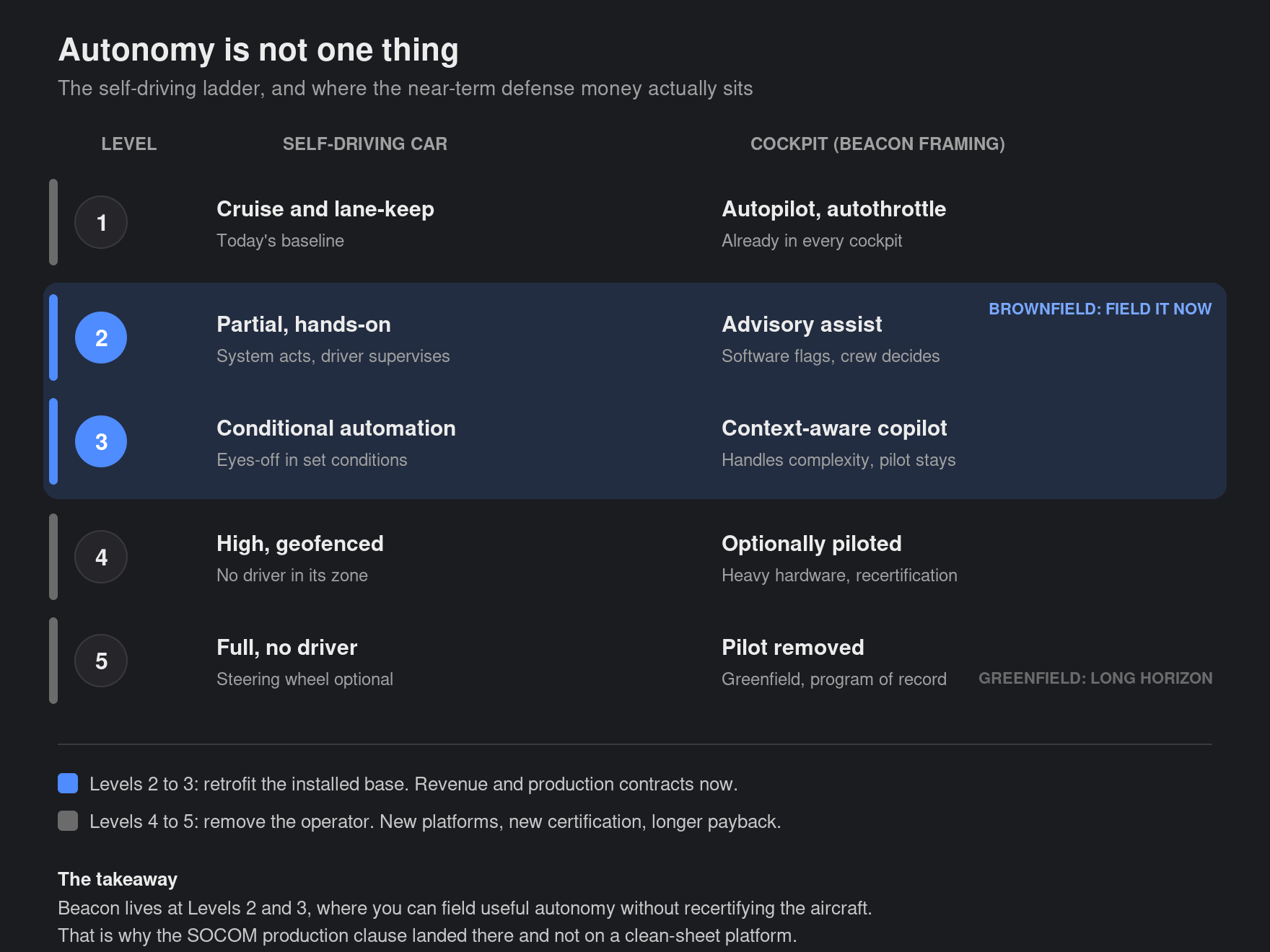
Two defense companies made news this week, both selling something called autonomy, both chasing opposite futures. Agon launched out of London with $23 million to build synthetic battlefields where new autonomous weapons learn to fight before they ever meet a real enemy. A few time zones west, in San Carlos, California, a company kept pushing more software inside crewed aircraft that are already flying real missions today. One bet replaces the pilot. The other makes the pilot better. Venture capital is in love with the first story. The Pentagon is signing production contracts for the second. The distance between those two facts is the most useful thing we can tell you this week.
The Deep Dive: Autonomy Goes Brownfield
Two roads out of the same trade
Defense autonomy has split into two businesses that share a word and almost nothing else. The greenfield road builds new uncrewed platforms from a clean sheet: strike drones, autonomous fighters, uncrewed surface vessels, the whole robot armada. The brownfield road takes the aircraft, ships, and vehicles the military already owns and makes them smarter with software. Greenfield gets the magazine covers and the unicorn valuations. Brownfield gets to revenue on a fraction of the capital. This week sharpened the contrast.
Why the installed base is the shortcut
Start with the physics of the defense budget. The United States operates thousands of crewed aircraft that will still be flying in 2040. Replacing them with autonomous platforms means clearing airworthiness, building new hardware, training a force, and winning a program of record from zero. Every one of those steps takes years and invites cancellation.
Retrofitting intelligence into an existing airframe skips most of that. The useful frame here is borrowed from self-driving cars, though aviation has no formal equivalent of the scale. Level 1 is today’s autopilot and autothrottle. Level 4 and Level 5 remove the pilot entirely, which is where the hard problems live: data maturity, heavy hardware, recertification, and a decade of program risk. The near-term money is in Level 2 and Level 3, the advisory band where software helps the crew manage complexity without triggering a full recertification of the aircraft. If the system rides on data, sensors, and a pilot interface rather than a heavy hardware install, it can field in months instead of decades. That is the brownfield bet: the fastest path to deployed autonomy runs through the fleet that is already paid for.
The government is voting with production clauses
Watch what the buyer signs, not what the market celebrates. Our portfolio company Beacon AI signed a four-year prototype agreement with US Special Operations Command this spring worth up to $49.5 million, and the agreement carries a production clause meant to move the software toward operational fielding across the 350-plus aircraft that SOCOM and Air Force Special Operations Command fly. Count the mobility work Beacon runs separately and the addressable fleet passes 1,400. That is a buyer paying real money to make crewed planes smarter, not to replace them.
Greenfield is getting production checks too, and the thesis has to survive that. In June the Air Force put both Collaborative Combat Aircraft into production, General Atomics’ FQ-42A and Anduril’s FQ-44A, four months ahead of schedule and against a target of more than 150 airframes by the end of the decade, with a separate six-year competition running for the autonomy software that will fly them. The first FQ-44A came off Anduril’s Ohio line in late July. So the question is not whether a clean sheet can reach production. It is what each dollar has to clear to get there. Beacon needed a prototype agreement and a software release. CCA needed two new airframes, a live-fire campaign, a billion-dollar factory, and the better part of a decade.
The pattern showed up again in the week’s biggest defense dollars, and none of them came from venture funds. The Navy awarded General Dynamics Electric Boat and HII a combined $76.6 billion for nine more Virginia-class and five more Columbia-class submarines, which Representative Joe Courtney called the biggest shipbuilding award in modern American history. The Space Force put $615 million into a second round of space-based airborne moving target indicator work, $397 million of it to Rocket Lab, with Systems and Technology Research and one undisclosed vendor splitting the rest. Note what that second award is. Not the constellation, which SpaceX won in May at up to $4.16 billion, but a deliberate hedge against depending on a single technical solution. One check buys more of a proven platform. The other buys insurance on a new one. In both cases the government, not the private market, is absorbing the risk of scale.
The commercial tell
There is one more reason to favor the retrofit layer, and it does not appear on any Pentagon slide. Brownfield autonomy has a civilian buyer. Beacon says it already works with several commercial airlines, and the same software that helps a special operations crew manage a long, high-workload sortie helps a regional carrier fly safer and burn less fuel. Greenfield military drones have a far thinner second market. There is a civil uncrewed industry in delivery, cargo, agriculture, and offshore survey, but it is small, slow, and buys nothing that resembles a strike drone. A platform that assists the pilot can amortize its research across airlines and militaries at once, which lowers the cost of capital and widens the moat. Dual-use is not a slogan here. It is a structural advantage that the brownfield side of the trade owns far more cleanly.
The counterargument, and why it is weaker than it looks
The greenfield bulls have a fair rebuttal. The future is uncrewed, they say, and retrofits are a bridge that gets torn down once the autonomous platforms mature. Two things blunt that. First, bridges collect tolls for a long time, and the crewed installed base is measured in thousands of airframes with service lives running past 2040. Second, the better objection is defensibility: is brownfield software just a feature that a prime can absorb? The answer turns on data. A platform that spreads from hundreds of aircraft toward a four-figure fleet accumulates high-context flight data that competitors cannot easily replicate, and that data compounds into the product. The open question is how much of it a vendor gets to keep, since the government holds broad rights to what its own aircraft generate. Answer that one well and this is the difference between a feature and a moat.
The Investment Takeaway
We think the near-term returns in defense autonomy are in brownfield, not greenfield. New North Ventures backs both sides of this market, but the timing math favors the retrofit. Software that rides the installed base can reach revenue and a production clause on a fraction of the capital and calendar a clean-sheet platform needs to get to the same place. The production clause is the tell. It is the buyer signaling that a capability is real enough to field, and the cheapest ones to earn are landing on the companies making the existing fleet smarter. When you underwrite an autonomy deal, ask one question first. Does this need a new platform and a new program of record to earn a dollar, or can it ride something already flying? Right now the second answer is worth a premium.
The Funding Ledger
Dual-use and defense-relevant rounds that crossed the wire the week of July 28 to August 3.
Agon (United Kingdom): $30 million total, a $7 million pre-seed led by Lakestar plus a $23 million seed led by XYZ Venture Capital and Lux Capital with Northzone. Synthetic battlefields to train defense AI, including counter-drone work against swarms. London, with a second office in Berlin. The week’s only pure-play defense round.
K2 Space (United States): $500 million Series D at a $6.8 billion valuation, led by Kleiner Perkins and ICONIQ, with Lightspeed, CapitalG, Altimeter, Spark, Sands, ARK, and T. Rowe Price accounts participating. Large high-power satellites, now past $1 billion raised. The Space Force is a named customer, and K2 has Golden Dome work with Anduril and a supply commitment under the Protected Tactical SATCOM-Global program through SES Space and Defense.
Multiverse Computing (Spain): a Series C targeting up to $570 million at a $1.7 billion pre-money valuation, co-led by Forgepoint Capital International, BNP Paribas’ Solar Impulse Venture Fund, and Bullhound Capital. Quantum-inspired compression that shrinks AI models onto smaller hardware, an edge and dual-use story. Announced July 27, just before this window, and the round is still open to additional strategic investors.
Onyx (Israel and United States): $113 million Series B at a reported $640 million valuation, led by Bessemer with TCV, Cyberstarts, Conviction, FirstMark, Vintage, QuantumLight, and G Squared. Onyx Security runs a control plane to discover, monitor, and govern enterprise AI agents. New York and Tel Aviv.
Act Security (Israel): $60 million across two rounds announced together, a $20 million seed led by Team8 and Bessemer and a $40 million Series A led by Notable Capital with Startpoint Capital and SVCI. Action-centric cloud access control spanning humans, workloads, and AI agents. Founded by the team behind Medigate.
Hush Security (Israel): $30 million Series A, with Akamai joining as a strategic investor alongside existing backers Battery Ventures and YL Ventures. $41 million raised to date. Identity and access control for AI agents and other non-human identities. Founded by the team that sold Meta Networks to Proofpoint.
ZuriQ (Switzerland): $25.5 million seed, led by Quantonation with Forward.one, Extantia, and Firgun Ventures. Trapped-ion quantum processors on a 2D Penning micro-trap architecture. An ETH Zurich spinout.
Read the pattern, not the list. One pure-play defense company raised this week, and it raised $23 million. The week’s biggest round, half a billion dollars into K2 Space, went to a dual-use satellite company with real Space Force and missile-defense exposure, which is the more interesting fact. Everything else went to the agent-security layer and to deep-tech infrastructure. Private capital is funding the substrate that autonomous systems will run on, while the government writes the checks for the platforms themselves. Procurement budgets always dwarf venture rounds, so the size gap between the Navy and Sand Hill Road is not the signal. The signal is which layer venture will underwrite without a program of record behind it.
The Northeast Desk
New Hampshire first. In Manchester, Vibrac Precision Test Systems is a 25-person shop whose calibration systems qualify the ball bearings that go inside Patriot missiles. Lockheed Martin is scaling PAC-3 MSE output from roughly 600 a year toward 2,000 over seven years, and Vibrac’s chief executive says he expects orders north of $100 million over the next four years. That is a small Granite State supplier riding a very large restocking cycle, and it is exactly the kind of company that never makes a national defense-tech list.
New Hampshire’s aerospace sector also had a moment abroad. Senator Jeanne Shaheen co-led a bipartisan congressional delegation to the Farnborough Air Show in July with Senator Jerry Moran, and championed a record New Hampshire industry contingent there, where aerospace stood out as the state’s top export sector at $1.7 billion in exports and 24,000 jobs in 2025. SENEDIA used the show to announce the Senator Jeanne Shaheen Aerospace and Defense Scholarship for young women entering the field. Retail politics and industrial policy in the same handshake.
Down the coast, the submarine industrial base got the check it had waited nearly three years for. The Navy awarded General Dynamics Electric Boat in Groton, Connecticut, along with HII’s Newport News Shipbuilding, a combined $76.6 billion for fourteen new submarines, work that will drive thousands of hires across southern New England through the end of the decade. Every hull pulls on a supplier web that runs up through Rhode Island, Massachusetts, and into New Hampshire and Maine machine shops. The region has been standing up training pipelines from Connecticut community colleges to the yards for years, and the award finally gives those hires a decade of visible demand to plan against. If you make pressure-hull hardware or precision components in this region, your order book just changed.
Mark the calendar. SENEDIA’s Defense Innovation Days, the twelfth annual, returns to the Newport Marriott in Rhode Island from August 31 to September 2. It is the one room where New England primes, startups, and Navy program offices are all in the same place.
Portfolio Corner: Beacon AI
Beacon AI is a New North Ventures portfolio company, and it is the cleanest example we have of the brownfield thesis in practice. The Silicon Valley company builds a software-first, hardware-light platform that augments pilots rather than replacing them. Its two products, Murdock and Lighthouse, sit on top of an aviation data platform that folds together aircraft data, weather, routing, and pilot actions to do three things: assist the crew in the moment, route around threats and weather, and monitor aircrew readiness on long missions.
The number that matters is the contract. In April, Beacon signed what it says is its thirteenth Department of Defense agreement, a four-year prototype OTA with US Special Operations Command worth up to $49.5 million, with participation from Air Force Special Operations Command and a production clause built in. The company frames its work as Level 2 and Level 3 pilot assistance, its own borrowing of the self-driving scale rather than any FAA standard, a deliberate step beyond autopilot and a deliberate step short of removing the pilot, precisely because that is the band where you can field useful autonomy without triggering a full aircraft recertification. Chief executive Matt Cox put the pitch plainly: “We build systems that help crews avoid unsafe actions, improve performance, and execute complex missions more effectively.”
The strategic logic is the data. Beacon’s platform is designed to spread across a special operations fleet of more than 350 aircraft, and a mobility fleet of more than a thousand beyond that, and every aircraft it touches produces high-context flight data that improves the product and is hard for a competitor to replicate. That is the difference between a feature and a moat, provided the data rights land the right way. We will be watching for the first production decision under the SOCOM agreement and for the platform’s move toward a formal program of record.