
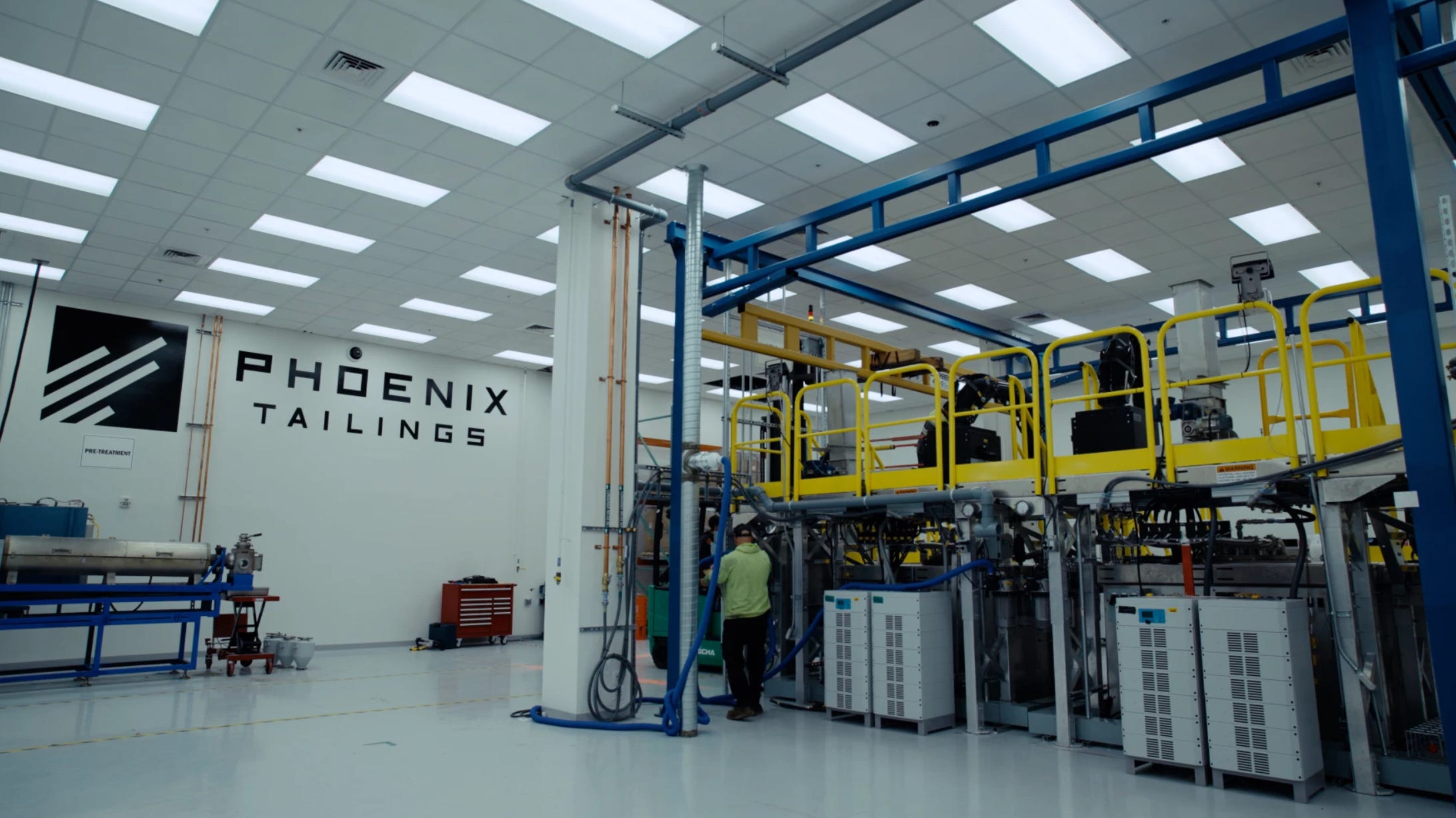
There is a company in Exeter, New Hampshire that has raised $117 million in venture capital across the life of its Series B. In the last eight weeks, the federal government has committed $566 million to it.
That ratio is the story. Not the rare earths, not the tailings, not even the China dependency that makes the investment urgent. The ratio. Federal capital is now arriving in quantities that complement private markets, in instruments that look less like grants and more like the growth rounds a crossover fund used to write. It is happening at the exact moment the traditional exit path for defense companies is getting narrower. Founders and investors are going to have to decide what that means.
What Phoenix Tailings actually got
On June 16, the Office of Strategic Capital at the Department of War signed a conditional commitment for a $500 million long-term loan to Phoenix Tailings. Two weeks earlier, the Department of Energy awarded the company $66 million under its Rare Earth Elements Demonstration Facility Program, against a $148 million total project cost with $82 million in non-federal cost share.
Phoenix processes mining waste or tailings into rare earth metals. Its Exeter facility opened last October, runs with about 30 people, and produces neodymium-praseodymium and dysprosium-iron alloys at an initial 200 tons per year with a stated path to more than 1,000. The OSC loan funds expansion at the existing Massachusetts and New Hampshire sites plus construction of a new separation and metallization plant the company calls the Freedom Facility. The site has not been announced.
Two things about that loan deserve emphasis, because most coverage skipped them. It is conditional, meaning nothing has been disbursed and financial close depends on due diligence not yet complete. And it is debt, not equity. Nobody took a board seat. Nobody took a preference. The cap table did not move.
Compare that to what Phoenix raised privately: a Series B that closed in three tranches, $43 million in December 2024, $33 million more in April 2025, and a $40 million amplification in February 2026 that was itself $30 million of equity plus $10 million of venture debt.
The federal commitments are roughly five times the venture capital, and they cost the founders nothing in ownership.
Why the money is there
This is the Federal Government investing in components and capabilities. It is that the IEA puts China at roughly 91% of global refined rare earth output and 94% of sintered permanent magnet manufacturing, and Beijing has spent fifteen months demonstrating what it intends to do with that position. Export licensing controls landed on seven medium and heavy rare earths in April 2025, expanded to processing equipment in October, and reached extraterritorially to foreign-made products containing Chinese-sourced material on December 1.
The affected elements are not exotic. Dysprosium and terbium are what keep a neodymium magnet from demagnetizing when it gets hot, which is to say they are what make a missile actuator work. An F-35 carries about 920 pounds of rare earth material. An Arleigh Burke destroyer carries 5,200. A Virginia-class submarine carries 9,200.
OSC Director David Lorch was direct about where the gap is: rare earth midstream processing capabilities are, in his words, “key shortage areas that need to be rapidly addressed.” Midstream, not mining. Separation and metallization. There are two or three facilities outside China that can do it. One of them is in Exeter.
The same pattern, at the other end of the check size
Phoenix is the large version. The Defense Innovation Unit is running the small version, and the mechanics are worth understanding because they are showing up in more and more pitch decks.
DIU has leaned hard into prize challenges under 10 U.S.C. 4025. The Mine Countermeasure Modernization challenge carries a $10 million purse. The Autonomous Vehicle Orchestrator challenge carries a ceiling up to $100 million. Specular MIST, which closed its first phase today, carries $5 million for maritime electronic warfare. Ground-Based Affordable Mass closes August 5 and sits inside a $250 million program budget.
For scale: as of last September, the largest prize purse in the history of the Department of Defense was $1.85 million. Federal prize spending across the whole government was $247,000 in FY2011. Something genuinely changed.
But look at what winning actually pays. Five companies won the Drone Dominance Lethality Prize Challenge in May, including Bravo Ordnance and Northrop Grumman. The cash prize was $10,000. What mattered was a government-funded safety review worth roughly $500,000 per vendor, preferred-provider status, and a pathway into a Phase 2 procurement of 60,000 units.
Bravo’s Kevin Landtroop said the thing out loud: winning “absolutely changed the caliber of discussion we’re having with investors, suppliers, other customers/partners.”
That is not financing. That is customer-validated due diligence, performed in public, for free. Which is arguably worth more than the check.
The discipline this requires
This additional source of capital to founders is an amazing accelerant. Founders should explore this financing route but be eyes wide open about several factors.
Federal capital is politically volatile in a way venture capital is not. DIU’s appropriation went from $87 million in FY2022 to $983 million in FY2024, a 431% increase. Enacted FY2026 came in at $430 million, less than half the peak and roughly half what the House itself passed. Announced challenge ceilings are rising on a shrinking base. A company that underwrote to the FY2024 trajectory is in trouble.
Announcements are not obligations. The Phoenix loan is conditional. DIU’s own Specular MIST solicitation states plainly that “there is no guarantee that follow-on awards or contracts will be awarded.” GAO found DIU awarded 450 prototype agreements from FY2016 to FY2023 with about $1.7 billion obligated, and 51% of completed prototypes transitioned to production. That is a good number by government standards. It is a coin flip by underwriting standards.
The exit math got worse while the funding math got better. US defense tech M&A ran 18 deals worth $4.6 billion in 2025. Through May 22 of this year it ran 14 deals worth $1.2 billion, per White & Case. Deal count held. Average deal size fell from roughly $256 million to $86 million. Meanwhile venture funding into the sector hit $14.6 billion across 107 rounds through May, against $9.6 billion and 206 deals for all of 2025. More money in, less value out the middle. The primes are writing venture checks instead of acquisition checks.
The Investment Takeaway
Non-dilutive federal capital is the most underpriced input in defense tech right now, and it is being systematically misread in both directions.
Founders who chase it as a substitute for revenue end up building companies whose only customer is an appropriations cycle. Investors who see a press release about a $250 million challenge and mark it as $250 million of pipeline are marking a lottery ticket.
The correct read is narrower and more useful. Federal capital is an accelerant on top of a commercial thesis, and its real value is signal, not cash. Phoenix Tailings did not get $566 million because Washington liked the pitch. It got it because it built an operating plant in New Hampshire that makes metal the country cannot otherwise buy, and the government confirmed that by underwriting the next one.
We underwrite to the commercial business. We treat the federal commitment as third-party diligence we did not have to pay for. And we want to be early enough that when the government does show up, it is a step-up rather than a rescue.
The Funding Ledger
Dual-use rounds announced the week of July 20.
Antares, $470 million Series C led by Paradigm and Caffeinated Capital, structured as $370 million equity plus $100 million debt. Compact nuclear microreactors for US military installations, targeting 2028 deployment.
Cathedral, $160 million at a $1.4 billion post-money valuation, led by Andreessen Horowitz and Sequoia. AI-driven military cyber operations, founded by four former DOGE staffers.
Enigma, $71 million seed led by Index Ventures and Ribbit Capital. Robot-agnostic AI models and interfaces, with more than 100 robots in the field collecting interface data.
Istari Digital, $22.6 million. Digital engineering software for military design workflows.
Nuclear Turbines, 15 million pounds led by IQ Capital. A BAE Systems spinout applying jet turbine technology to compact reactors.
ASIO Technologies, $15 million first institutional round led by Protego Ventures. Tactical command and control plus jam-resistant navigation for GPS-denied environments.
1872, $15 million seed led by The O.H.I.O. Fund. Autonomous steel fabrication with coordinated robotics.
Two of the three largest rounds this week were nuclear. That is not a coincidence and it is not really an energy trade. Antares is selling power to installations, and Nuclear Turbines is a defense prime spinout. Compute demand and base resilience are converging on the same hardware, and the capital is following the convergence rather than either sector on its own. New North Ventures’ StarCube continues to execute as well.
One note on method: a $180 million Series A for the endpoint security company Glow was widely reported this week, but Crunchbase’s own roundup lists the same round with the same lead at $100 million. We are holding it until the discrepancy resolves rather than printing a number we cannot stand behind.
For context on the week before: Helsing raised $1.8 billion at an $18 billion post-money valuation on July 13, led by Lightspeed and General Catalyst. It is the largest defense startup round in European history, and the company’s emphasis that it remains “predominantly European-owned” is doing real strategic work.
The Northeast Desk
Hooksett, NH. Marmon Defense broke ground on a $40 million, 350,000-square-foot manufacturing plant on July 16, more than four times its current footprint. The plant makes naval cables and wiring for Navy shipbuilders in Mississippi and Virginia. Roughly 80 jobs next year, 400 over five years, completion targeted June 2027.
Londonderry, NH. Envision Technology cut the ribbon on July 7 for the Village at Technology Park, a 110-acre development anchored by a 234,000-square-foot headquarters. Envision builds electro-optical and infrared systems and holds two five-year DoD contracts totaling $350 million. Expected 1,500 permanent jobs. Founder Ken Solinsky previously built Insight Technology and sold it to L-3 Harris. The development includes 440 apartments and a 200-child childcare center, which is the most honest answer anyone in New England has given to the defense workforce problem.
Andover, MA. Raytheon won a $1.8 billion SPY-6 radar production and sustainment contract on July 21, with options that could take it to $3.3 billion. RTX has put more than $800 million into modernizing radar manufacturing and plans to double SPY-6 output by 2028.
Maine. The state’s Forest Bioproducts Advanced Manufacturing hub won $20 million on July 27, the only New England award in a $169 million, six-hub round that Commerce rewrote around national security criteria. Worth reading as a signal about what federal innovation money now rewards.
Worth knowing. The FY27 NDAA includes a CMMC assessment grant program offering up to $100,000 per small business, with roughly 840 New Hampshire firms eligible. If compliance cost is what is keeping you out of the defense supply chain, that is the door.
On the calendar. BlueTIDE 2026, the maritime and dual-use demonstration hosted by Polaris Tech Bridge with NUWC, runs August 26 and 27 in Newport. SENEDIA Defense Innovation Days follows August 31 through September 2, also in Newport. The NH Tech Alliance Innovation Summit is October 6, with its Speed Venture Summit on October 13.
Portfolio Corner: Auriga Space
Auriga builds electromagnetic launch systems. The long-term goal is a multi-kilometer accelerator that puts small satellites into orbit without a rocket. That is a decade-scale ambition, and the interesting thing about the company right now is what it is doing with the hardware in the meantime.
On July 1, Auriga opened the first commercial hypersonic weather-effects testing service, using its Prometheus magnetically levitated linear accelerator. The rig positions water droplets or particles in a test article’s flight path, drives the article through them at flight-representative speeds, and recovers it for analysis. Dozens of tests in a single week under repeatable conditions. Axiom Materials is the pilot customer, validating oxide-oxide ceramic matrix composites. Prometheus is already operating under Air Force and Missile Defense Agency contracts, and Auriga is now selling time on it commercially.
Two weeks later, on July 15, the company signed a three-year CRADA with the Army’s DEVCOM Armaments Center to evaluate electromagnetic launch as a counter-drone interceptor. The economics are the entire argument. An APKWS shot runs $25,000 to $40,000. A Stinger runs $430,000 to $480,000. A Patriot PAC-3 runs $4.2 million. Against mass drone attack, those numbers lose on their own. An electrically accelerated projectile carrying no propellant resets the cost curve, and the magazine depth is a function of how much power you can put behind it.
New North Ventures has backed Auriga since the seed. Founder and CEO Winnie Lai was profiled in Forbes on July 10.
Also in the portfolio: SensusQ, the Estonian intelligence-fusion company, was acquired by German drone maker Quantum Systems on July 10 as part of Quantum’s expansion into Tallinn. Terms were not disclosed. Congratulations to Marko Kaseleht, Villiko Nurmoja, and the team.
More links to explore
BETA Technologies unveiled the MV250 at Farnborough on July 20, an autonomous hybrid-electric VTOL for contested logistics, built in Burlington, Vermont with GE Aerospace propulsion and Sikorsky MATRIX autonomy.
Vatn Systems launched SIGURD, a two-module autonomous mine countermeasure system, out of Portsmouth, Rhode Island. A two-year-old company now competing against primes.
White & Case on defense tech M&A, the underlying data behind the exit argument above.
DIU’s open solicitations. Ground-Based Affordable Mass closes August 5. SWAP-USV closes August 10.